
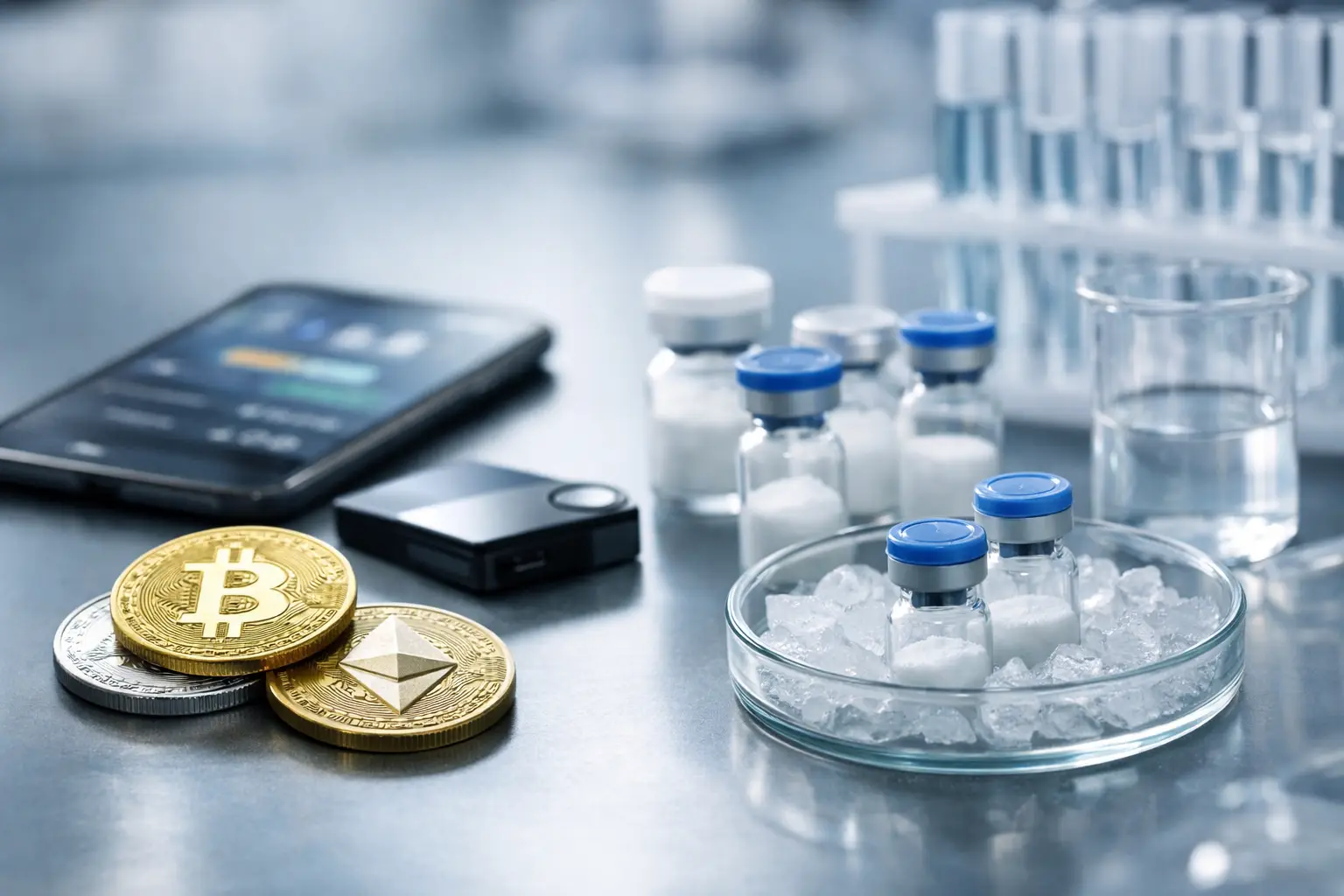
Cryptocurrency Payments for Research Peptides
A research purchase is only as reliable as the chain of controls behind it. Cryptocurrency payments for research peptides can offer a fast, direct checkout option, but the payment method should never become the basis for evaluating a supplier. Identity, purity, third-party testing, documentation, secure order handling, and Research Use Only compliance remain the controls that determine whether a procurement decision holds up.
For qualified laboratory and scientific research buyers, crypto is a payment rail. It is not a substitute for product verification, institutional purchasing procedures, or responsible recordkeeping.
What cryptocurrency payments change
Cryptocurrency transactions move differently than card payments or bank transfers. Once a transaction has been transmitted and confirmed on the relevant network, it is generally irreversible. That finality can reduce certain payment-processing delays, but it also raises the standard for buyer-side accuracy before funds are sent.
The practical benefit is choice. Some research buyers maintain digital assets as part of their operating reserves or prefer a payment method that does not depend on traditional card limits. For an ecommerce purchase of in-stock research material, cryptocurrency can provide a direct route from approved checkout to order confirmation.
The trade-off is simple: there is less room to correct an error after payment. A copied wallet address, incorrect network selection, or payment sent outside the checkout flow may be difficult or impossible to recover. Buyers should treat the payment screen as a controlled procurement step, not a casual transfer.
Cryptocurrency value can also change quickly. The amount quoted at checkout may be tied to a short payment window because market prices move. Sending the correct asset after that window expires can create reconciliation delays. This is not a product-quality issue, but it is an operational consideration that a responsible buyer should understand before selecting crypto.
Cryptocurrency payments for research peptides require verification
The strongest research purchasing practice is to separate payment convenience from material qualification. A supplier’s ability to accept cryptocurrency says nothing, by itself, about peptide identity, stated purity, packaging controls, storage practices, or fulfillment standards.
Before choosing any payment method, buyers should confirm that the listing clearly identifies the compound and milligram format, that a certificate of analysis is available, and that the supplier states a defined purity threshold. A documented standard such as Purity >=99%, supported by third-party testing and vial-level verification, provides materially more useful procurement evidence than a payment badge in a checkout footer.
Documentation should be evaluated with the same discipline applied to the compound itself. A COA should correspond to the material being purchased and provide enough information for a qualified buyer to assess the stated identity and purity specification. If a product page, batch record, or verification process is unclear, the appropriate response is to pause the order and obtain clarification before payment is initiated.
Research peptides must also be sold and handled within clear boundaries. Materials designated Research Use Only are not for human consumption, diagnostic use, therapeutic use, or use as a drug, supplement, or medical device. Cryptocurrency does not alter those restrictions. The purchaser remains responsible for ensuring the intended use, institutional handling, and ordering authority are appropriate.
Check the checkout environment before sending funds
Because a crypto transfer is final, checkout security deserves deliberate attention. Start from the supplier’s official website rather than a search advertisement, social-media message, or a wallet address received through an unverified channel. Confirm that the browser address is correct and that the checkout page is secured through the site’s normal purchase flow.
At the payment stage, review the selected asset and network carefully. Tokens with similar names may exist on multiple networks, and selecting the wrong one can prevent proper crediting. Verify the payment amount, account for any network fee requirements, and complete the transfer within the displayed payment period.
Do not rely on screenshots, forwarded addresses, or direct messages claiming to provide an updated wallet destination. A legitimate ecommerce transaction should generate an order reference and payment instructions within the established checkout sequence. If anything changes unexpectedly, stop before sending funds.
Build records that match the purchase
A professional procurement file should connect the payment to the material received. This matters whether the payment is made by card, ACH, wire, or cryptocurrency. Digital-asset payments simply require a few additional identifiers.
Retain the order confirmation, transaction hash, date and time of transfer, asset used, network used, amount sent, quoted USD value when available, product description, lot or batch information, COA, and shipping confirmation. Keep these records with the laboratory’s normal purchasing and receiving documents rather than leaving them only in a personal wallet application.
For organizations with purchasing controls, the buyer should obtain internal approval before checkout and use the approved account or wallet process. Personal wallets, informal reimbursements, and missing transaction documentation can complicate accounting even when the product itself is properly documented. The exact recordkeeping standard depends on the organization, but traceability should not depend on memory.
Receiving controls matter as well. When the shipment arrives, compare the order confirmation, package labeling, and any supplied verification information with the expected material. Note discrepancies promptly and preserve the packaging when an issue needs review. Payment confirmation proves that a transfer occurred. It does not replace incoming-material verification.
Fraud prevention is part of quality assurance
Crypto users are frequently targeted by impersonation attempts because transfers cannot usually be reversed. The most common failure is not a flaw in cryptocurrency itself. It is a buyer being directed away from a legitimate checkout process by a fake customer-service account, a lookalike website, or a fraudulent payment address.
A few controls prevent many avoidable losses. Use a bookmarked official site, verify communications through known company channels, and never send a second payment because an unverified message claims the first one failed. If a payment appears pending, consult the transaction record and the order status through the authorized account before taking action.
For higher-value orders, a small test transaction may be appropriate only when the checkout process explicitly supports it and the supplier’s payment instructions permit it. Otherwise, partial or separate transfers can create matching problems. Follow the stated checkout procedure exactly.
Where crypto fits in a disciplined purchasing process
Crypto can be a practical option for buyers who understand the asset, have approved internal procedures, and can maintain clean transaction records. It may be less suitable when an organization requires chargeback rights, centralized card controls, or payment terms that digital assets do not support. There is no universally superior method. The right choice depends on the research buyer’s controls, treasury practices, and tolerance for transaction finality.
At Ember Peptides, payment choice sits alongside the evidence that should guide every research-material order: third-party tested compounds, stated purity standards, COAs, USA distribution, and clear Research Use Only restrictions. Those are the signals that deserve scrutiny before a buyer reaches checkout.
A buyer who verifies the supplier first, reviews the order second, and sends payment last is using cryptocurrency as it should be used: a precise transaction method within a controlled research procurement process.